
Build it with medical data.
Generative AI such as Claude Code does the implementation; people own the design and the verification. Corporate training in AI-driven development — agentic coding — learned by building something that runs with medical data.
- 2 days · 12 hours
- Hands-on with medical data
- Nothing to install
From vibe coding to AI-driven development you can explain
Code nobody can explain goes into your work
You can explain what the AI wrote
The goal: explain in your own words what the AI wrote — and check it.
Build a workflow app in two days with
medical data × Claude Code
Day 1 builds the way of working; on Day 2 each team finishes one build drawn from its own work.
Build a workflow app with medical data × Claude Code — AI-driven development in practice
Get the flow of handing development to AI
- Have the AI plan, implement and verify
- Run the full loop once on a small task
Read and explain the code AI wrote
- Read the diff and explain it in your own words
- Write your business context into instructions
Designing for safe delegation
- Draw the data line and set permissions
- Organize requirements; have the AI plan
Finish one build as a team, and verify it
- Finish it and check the results are right
- Present it and plan how to keep going
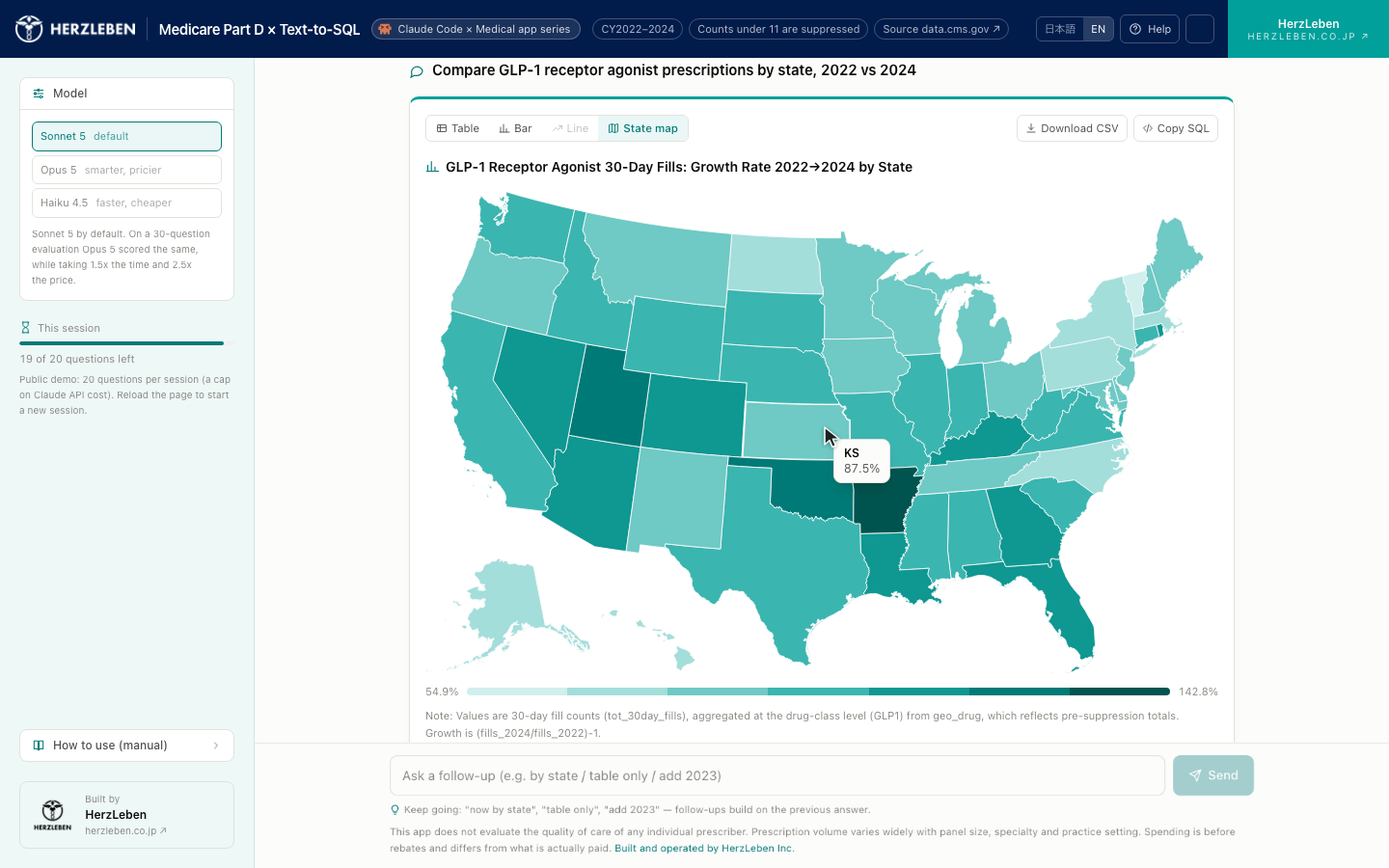
Examples: an app that queries public medical data in natural language / a pipeline that runs the monthly aggregation and reporting on its own / a tool that ingests and reshapes multiple files. The data is public medical data, or your own data under an NDA.
We provide the development environment. It runs in the browser, so there is nothing to install on participants’ PCs and nothing to request from IT. No time is lost to setup.
- All code written during the program
- Claude skill definitions, ready to use in-house
- Follow-up support after the program
The same format, different builds
Same approach as 01 — two days, 12 hours. Only what you build changes.
Build an analysis & visualization app
Load the data, aggregate it, show it
- Join multiple files and aggregate them
- Charts and tables, switchable with filters
Automate repetitive work
Turn monthly manual tasks into something you can run
- Carve out what can be automated
- Replace the steps with code and check them
Generate Excel files and reports automatically
Replace the work of producing deliverables
- Break monthly reports into something generatable
- Output Excel with formatting, totals and charts
Build a data processing pipeline
No more manual copy and paste
- Turn preprocessing into a flow you can re-run
- Keep definitions so results can be verified
Delegating safely in healthcare and pharma
The more you hand to AI, the more people must decide up front. The training builds on these four ground rules.
Separate data the AI may see from data it may not
Handling personal and unpublished information, and substituting public or dummy data
Narrow what the AI is allowed to do
Settings that keep what it can read, write and run to a minimum
Nothing goes through until a person has read it
How to read a diff, and how to tell changes to accept from changes to stop
Keep a record of what the AI was asked to do
Instructions and change history kept so the work can be verified and explained later
Why we teach with medical data
Medical data calls for judgment that generic sample data never raises — and only people who know what is inside the data can teach it.
No clear denominator
How to set the patient population
Codes change
Absorbing yearly revisions
Small cells stay hidden
How to suppress small numbers
Can it go in the report?
The call before a number is published
From first call to training day
- 01
Enquiry
Who attends, and what they should be able to do
- 02
Pick the subject
Chosen from the team’s own work
- 03
Timetable & materials
Including documents for internal procedures
- 04
Two-day training
On-site or live online
- 05
Follow-up
Support for keeping it going at work
Please get in touch about two months before your preferred start.
Track record
We have taught in programs delivered with training companies and in a university course for medical data scientists. Client names are withheld; only the theme and audience are listed.
FAQ
Is this a course on how to use Claude Code?
No. It teaches a way of working — handing implementation to AI while people own design and verification (AI-driven development, or agentic coding). Participants learn Claude Code along the way.
Can we take it with Codex or other tools?
Exercises mainly use Claude Code, but the approach is the same whichever tool you use. Ask us about running it with the tools you already have in-house.
Do participants need programming experience?
No. The goal is not to write code but to read, explain and check what the AI wrote.
Can we use our own data?
Yes, under an NDA. If you have none to bring, we run the same format on public medical data.
We are concerned about information security.
The four points in section 03 above are built into the program. We provide the development environment, so nothing is installed on participants’ PCs. We can also adapt the approach to your internal policies.
Can the program be used with Japan’s human resource development subsidy?
Yes, we support programs planned around the subsidy. Hours, curriculum and schedule are set to meet the requirements of the training plan filing.
CONTACT
Tell us who the participants are and what you want them to be able to do afterwards, and we will propose a program.